
What it's marketed for
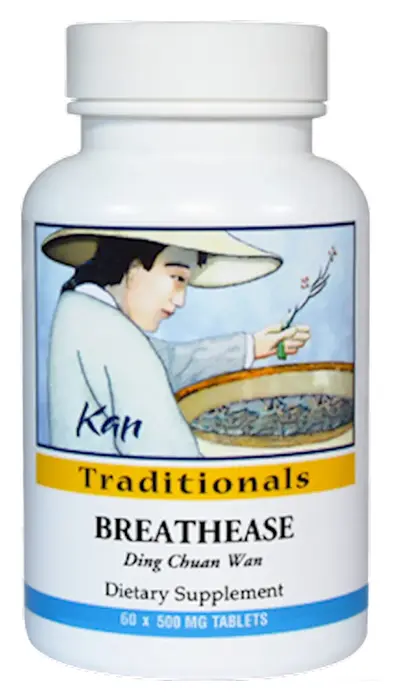
BreathEase is Kan Herb Company's version of Ding Chuan Tang ("Arrest Wheezing Decoction"), a classical Chinese herbal formula first published in 1550 in the Ming-dynasty text She Sheng Zhong Miao Fang. Traditionally, it's used for coughing and wheezing tied to a specific pattern: Wind-Cold invasion sitting on top of a pre-existing Phlegm-Heat condition in the Lungs. Kan's own product page describes the formula's action as redirecting "rebellious Qi downward," clearing "Heat from the Lungs," and transforming "Phlegm" — that's the manufacturer's own traditional-medicine framing, not a claim we're making about what the capsule will do for any individual. The same page states plainly that the formula should not be used for a Wind-Cold pattern alone or for Cold in the Lungs — a different presentation than the one it's built for.
What we found
The label lists eleven named botanicals as a single proprietary blend totaling 1,000mg per two-tablet serving: ginkgo seed, white mulberry root bark, platycodon root, perilla fruit, ginger-cured pinellia rhizome, apricot seed, Chinese skullcap root, honey-fried stemona root, Chinese licorice root and rhizome, purple aster root and rhizome, and cynanchum root and rhizome. We checked three separate listings of this product — Kan Herb Company's own site, and two public herbal retailers — and none of them breaks that 1,000mg total down into an individual amount for any of the eleven herbs. Suggested use across every listing we checked is 2–3 tablets, 2–3 times daily, or as directed by a practitioner.
One thing worth knowing in BreathEase's favor: the classical Ding Chuan Tang decoction that this formula is based on traditionally includes Ephedra sinica (ma huang) as a core ingredient. Kan's encapsulated version does not list ephedra anywhere in its ingredient panel. That matters because the FDA banned dietary supplements containing ephedrine alkaloids outright in 2004, citing an unreasonable risk of heart attack, stroke, and death from that class of ingredient. We're not saying BreathEase is claiming any connection to that history — we're flagging it as useful, verifiable context for why an over-the-counter capsule based on a classical decoction looks different from the original recipe, and it's a point in the product's favor, not against it.
The label, in more detail
Kan Herb Company was founded in 1987 by practitioners who wanted a US-based, quality-controlled source of Chinese herbal formulas for their own profession. The company manufactures its products from imported Chinese herbs at its own facility in Santa Cruz, California, which it states meets or exceeds FDA current Good Manufacturing Practice (cGMP) requirements. Kan says it controls procurement, in-house testing, manufacturing, and packaging itself rather than outsourcing those steps, runs both in-house and independent laboratory testing for identity, purity, heavy metals, pesticides, and microbial contamination, and publishes Certificates of Analysis online per product. That's a real, verifiable manufacturing track record — a different picture than the undisclosed-manufacturer pattern we've flagged on other pages.
Published research on Ding Chuan Tang itself is real but limited to the classical decoction and its component compounds, not a clinical trial of this specific capsule. We found a molecular-docking study analyzing how the formula's active compounds interact with biological pathways linked to asthma, and a separate laboratory study describing reduced airway inflammation and eosinophil infiltration in ovalbumin-sensitized asthmatic mice given the decoction. Both are legitimate published research, and both stop well short of a human clinical trial of Kan's encapsulated product — worth knowing before treating either study as proof of what this specific bottle does.
Where it's sold, and a name to watch for
Kan Herb Company's own site requires visitors to log in with a practitioner account before it will show a price or allow a purchase — a real access restriction consistent with the "professional use only" labeling. A dedicated acupuncture-and-herbal-supply retailer we checked, Golden Needle Online, has the identical gate: "Login as practitioner to purchase this product." But two other public herbal retailers we checked, Nutriessential and Well Being Holistic Pharmacy, sell the same product to any visitor with no login requirement at all, while still printing the same "FOR PROFESSIONAL USE ONLY" warning on the same page. We're not calling that a scam — both retailers are identifiable, real businesses, not anonymous storefronts — but it's a genuine inconsistency in how strictly that professional-use restriction is actually enforced depending on which seller you land on.
Separately, and worth knowing if you're searching: at least one completely different, unrelated product is sold under the exact same name "BreathEase" — a gummy/capsule blend of mullein leaf, butterbur extract, quercetin, nettle root extract, bromelain, and boswellia extract, listed by a different, less clearly identified brand and priced in UAE dirhams, with no guarantee disclosed on its listing. It shares nothing but a name with Kan Herb Company's product — none of the company history, testing claims, or traditional-formula sourcing described above applies to it. A third, separately-named product, "BreathEaseX," is also sold online through several near-identical "official" marketing domains common to this portfolio's other red-flag findings — it is a different product with a different name, not BreathEase, and not the subject of this page.
Pricing, as shown by public retailers
BreathEase isn't sold through our Amazon storefront, and given the gaps above we're not linking to a purchase page for it — this is the retailers' own published reference pricing, shown here for information only. Health & Vitality Daily doesn't process this purchase or earn a commission on it.
Nutriessential lists one size at $22.80. Well Being Holistic Pharmacy lists four separate sizes: $30.40 for 120 tablets, $69.92 for 300 tablets, $37.28 for a 2oz format, and $124.80 for an 8oz format. We did not find a product-specific money-back guarantee published on either retailer's page, on Kan Herb Company's own site, or on Golden Needle Online — only a generic site-wide refund-policy link on one retailer's site, with no BreathEase-specific terms stated.
This is the retailers' own reference pricing, not a monetized Amazon link. Health & Vitality Daily does not control this pricing, does not process the purchase, and earns nothing from it.
A single-ingredient alternative, no practitioner account needed
Instead of BreathEase, we're pointing readers to a standard single-ingredient mullein leaf supplement, such as Nature's Answer Mullein Leaf Capsules. Mullein leaf is one of the eleven botanicals in BreathEase's blend, and it's the one most commonly sold on its own with a clearly stated per-capsule dose and no practitioner-pattern differentiation required to use it. It isn't a replacement for the full eleven-herb formula above, and it won't address the specific Wind-Cold-with-Phlegm-Heat pattern BreathEase is traditionally used for — it's simply a transparently-dosed, publicly available alternative for general respiratory support.
See it on Amazon →As an Amazon Associate, Health & Vitality Daily earns from qualifying purchases. This link opens a live Amazon search for this exact product, not one specific listing we control — prices and sellers may vary.
Common questions
- Is BreathEase a scam?
- No — Kan Herb Company is a real, established manufacturer (founded 1987) with a verifiable US manufacturing facility and published quality-testing claims. The issues we found are transparency and access gaps, not signs of a fraudulent operation: undisclosed individual herb dosages, no published guarantee, and inconsistent enforcement of the "professional use only" restriction across sellers.
- Why isn't there an Amazon link to BreathEase itself?
- We couldn't find it sold on Amazon under this name, and given the dosage-transparency gap, the missing guarantee, and the fact that this is a pattern-specific formula meant to be matched to your presentation by a trained practitioner rather than self-selected, we're not comfortable linking to a purchase page for it. We've pointed to a single, transparently-dosed alternative instead.
- Does BreathEase contain ephedra, like the traditional formula it's based on?
- No. The classical Ding Chuan Tang decoction traditionally includes ephedra (ma huang), but Kan Herb Company's ingredient list does not include it. The FDA banned ephedrine-alkaloid dietary supplements in 2004 over cardiovascular risk, so its absence here is worth knowing as helpful context, not a concern.
- Do I need to be a licensed practitioner to buy it?
- It depends which seller you're looking at. Kan Herb Company's own site and at least one dedicated acupuncture-supply retailer require a practitioner login before showing a price. Two other public herbal retailers we checked sell it to any visitor with no login required, despite the same "professional use only" label appearing on their pages too.
- Is this the same product as "BreathEaseX"?
- No. BreathEaseX is a differently-named, differently-formulated product sold through unrelated marketing sites. It has no connection to Kan Herb Company's BreathEase covered on this page.
Sources
- Kan Herb Company, BreathEase / Ding Chuan Tang product page and Quality Assurance page (checked directly) — ingredient list, contraindication language, manufacturing and testing claims, practitioner-login purchase requirement
- Nutriessential, BreathEase product listing (checked directly) — public pricing, label warnings
- Well Being Holistic Pharmacy, BreathEase product listing (checked directly) — public pricing across four sizes
- Golden Needle Acupuncture, Herbal & Medical Supply, BreathEase listing (checked directly) — practitioner-login requirement confirmed independently
- Reference sources on the classical Ding Chuan Tang formula (Me & Qi, American Dragon, Attilio D'Alberto) — 1550 origin, traditional composition including ephedra, indicated pattern
- U.S. Food and Drug Administration, Federal Register final rule declaring ephedrine-alkaloid dietary supplements adulterated (2004); NIH Office of Dietary Supplements, Ephedra fact sheet
- Published laboratory research on Ding Chuan Tang: a molecular-docking study of its active compounds, and a study of the decoction in an ovalbumin-sensitized asthmatic mouse model
- Whlsome, differently-formulated product also sold under the name "BreathEase" (checked directly, for name-collision disclosure only)